| By: danps Thursday September 5, 2013 1:46 pm |
|
Cross posted from Pruning Shears and
FireDogLake (attribution--got that???)
There is
new interest in a
2007 study by Don B. Kates and Gary Mauser. “Would Banning Firearms Reduce Murder and Suicide?” was published in Harvard’s
Journal of Public Law and Policy and has been cited recently on
a number of
political blogs,
message boards, even on a popular right-leaning
economics site. I
encountered it at
Writer Beat,
one of the sites where I cross post. Announcing the publication by
“Harvard, Obama’s Alma Mater” (apparently for the benefit of those who
didn’t already know the place was a suspicious liberal bastion), the
author summarizes its finding as “it’s not guns that kill people,” a
commonly repeated phrase elsewhere.
Since I’m a good, open minded lefty, I decided to dig in to the paper
and see if it challenged any of my beliefs. Before getting into the
content I checked out a couple things, though. First, “Harvard study”
conjures up images of nerdy, bespectacled professors with lab coats and
slide rules indifferently inquiring as to the nature of the universe.
(1) In this case, however, the authors’ backgrounds are decidedly partisan. Kates has written many
books and articles in favor of gun proliferation, and Mauser is a
lobbyist and enthusiast (
via)
on the issue. This doesn’t mean their opinions are invalid. Subject
matter experts develop opinions, and as long as those opinions are at
least arguably defensible there’s no problem. It’s good, though, for
people to know up front what authors’ dispositions are. In this case
it’s reasonable to expect a ringing endorsement of liberalized gun laws.
One other note: This does not appear to be a peer reviewed study. I
didn’t see any indication of it, anyway. Again that doesn’t make it
invalid, but it
does mean the paper hasn’t been properly interrogated and should be considered less rigorous as a result.
That out of the way, I started reading – and couldn’t get past the first paragraph without having to stop for a reality check:
There is a compound assertion that (a)
guns are uniquely available in the United States compared with other
modern developed nations, which is why (b) the United States has by far
the highest murder rate. Though these assertions have been endlessly
repeated, statement (b) is, in fact, false and statement (a) is
substantially so.
The “other modern developed nations” are not specified, so I went
with a list of those generally considered to be part of the West
and
that had a good amount of data available. That left a list of 20
nations. Kates and Mauser reference the Small Arms Survey; fortunately
this
Guardian article has the data linked in a spreadsheet. I’ve put a trimmed
version of it
in comma separated value (CSV) file on my site, so please feel free to
look at the numbers yourself. Note any inaccuracies and I’ll correct
them.
So is it, as the authors say, substantially false that guns are
uniquely available in the United States compared with other modern
developed nations? Here are the numbers (average firearms per 100
people) in descending order:
| United States |
89 |
| Switzerland |
46 |
| Finland |
45 |
| Sweden |
32 |
| Canada |
31 |
| France |
31 |
| Norway |
31 |
| Austria |
30 |
| Germany |
30 |
| Iceland |
30 |
| New Zealand |
23 |
| Northern Ireland |
22 |
| Belgium |
17 |
| Luxembourg |
15 |
| Australia |
15 |
| Denmark |
12 |
| Ireland |
09 |
| UK (England and Wales) |
06 |
| Netherlands |
04 |
| Liechtenstein |
(N/A) |
The US has nearly twice the gun ownership of the next closest
country. It’s number one by a huge margin, no contest. The only
substantially false thing is the very first factual assertion the
authors make in their paper.
Next the authors claim as 100% false the notion that the US “has by
far the highest murder rate.” They also spend a good deal of time on
Soviet/Russian murder rates, as though that is one of the industrialized
nations we should be comparing ourselves to and not, say, the UK.
There’s also this bizarre statement that seems to have wandered in from a
Red Scare pamphlet:
Since at least 1965, the false assertion
that the United States has the industrialized world’s highest murder
rate has been an artifact of politically motivated Soviet minimization
designed to hide the true homicide rates.
Right, so anyway on to homicide rates. Finding data for all the
countries in question over a period of years was difficult (which
may not be an accident), and I was not able to find complete data sets anywhere. The closest I found was the United Nations Office on
Drugs and Crime (UNODC), which has spreadsheets for both
overall homicide statistics and homicides
by firearms. Combining those two with a great deal of tedious copying and pasting
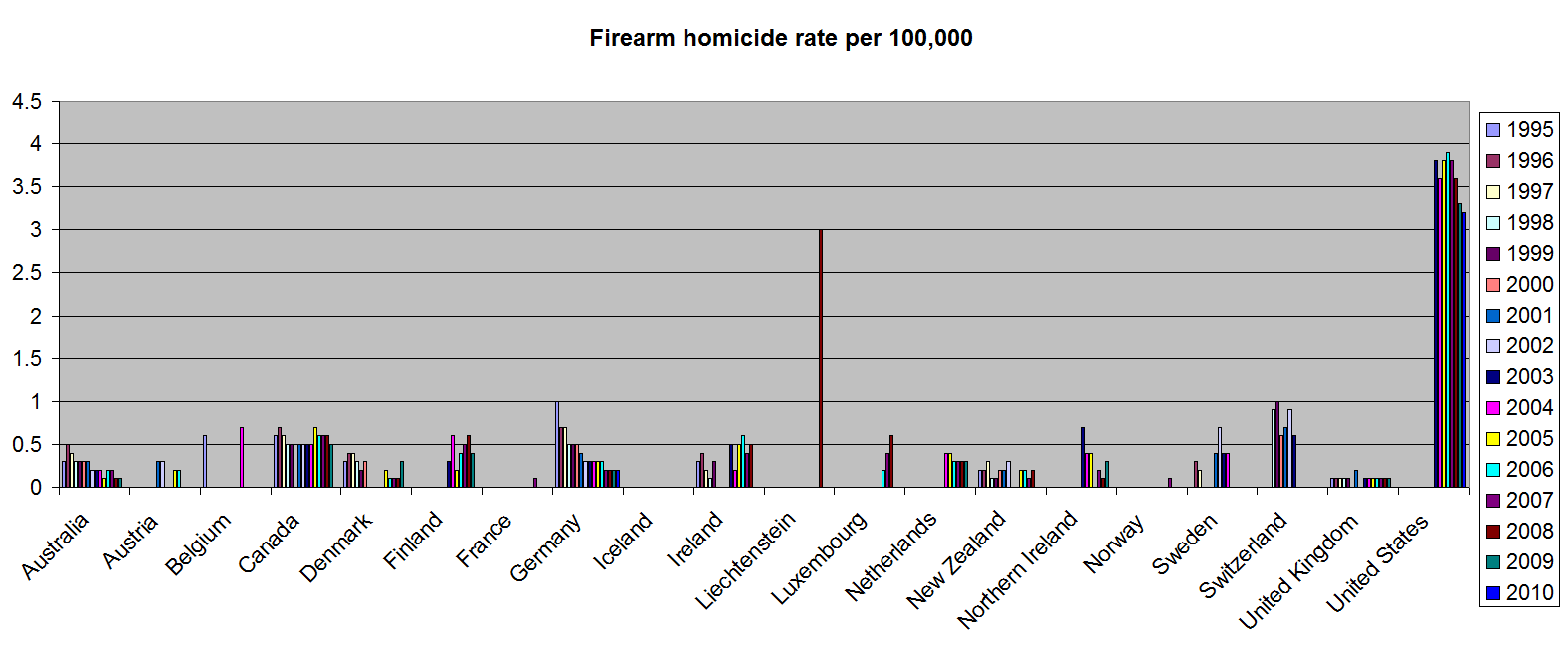
produced this (CSV) from which I created these graphs (click to enlarge):
(Mentally bookmark that big spike in 2008 for Liechtenstein.)
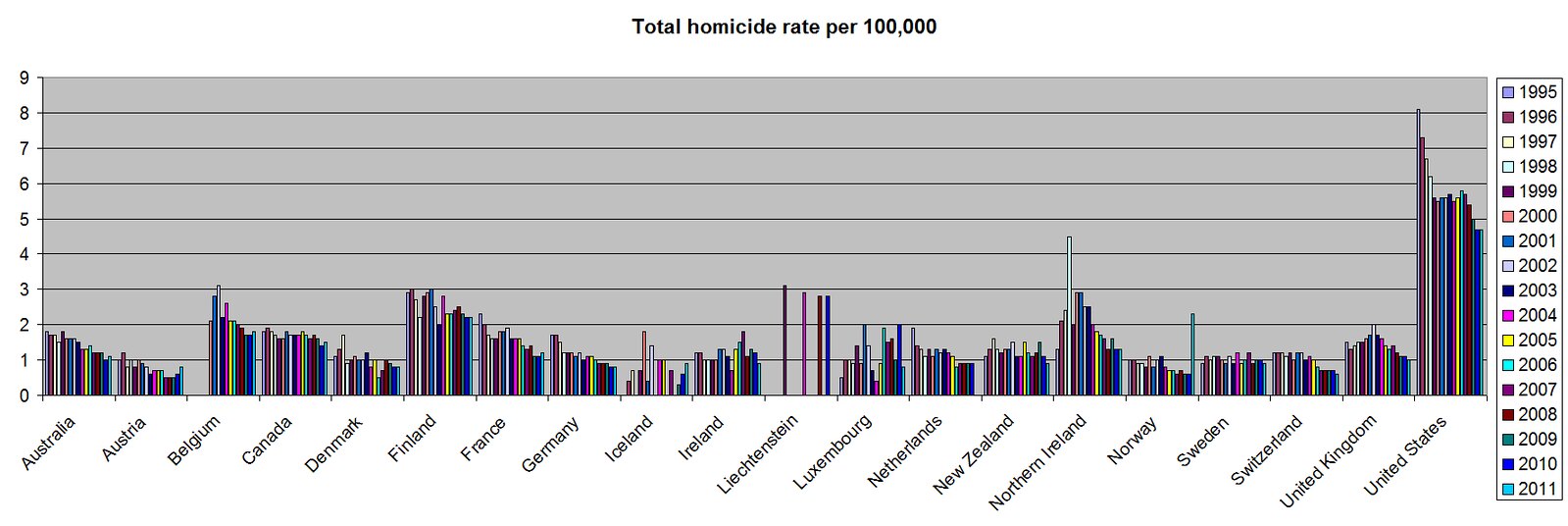
America’s overall homicide rate is first by a substantial margin, its
firearm homicide rate even more so. Once again it isn’t even close –
yet the authors claim it is a false statement.
So the paper begins with a pratfall. The problem is that establishing
just how silly it is required a lot of work. I burned much more of my
holiday weekend than I would have liked tracking down sources,
assembling it into a usable format and looking at the results. Bad
research takes time to correct, and examples like this show just how
much play unreviewed results can get. (And it isn’t the first time
even this year that a well publicized but unreviewed Harvard paper didn’t stand up to scrutiny.)
One more example of bad research. On the third page the authors
produce a table with European gun ownership and murder rates. Since the
US leads off the paper and plays such a central part in the debate it
seems a bit curious to exclude it (by restricting the table to European
rates). The inclusion of Russia is similarly weird if we are looking at a
Western perspective on gun laws and murder rates. But the really
unusual item in the table is Luxembourg. Look at that huge murder rate —
with no guns to speak of! The authors make sure the reader’s attention
is drawn to it as well: “For example, Luxembourg, where handguns are
totally banned and ownership of any kind of gun is minimal, had a murder
rate nine times higher than Germany in 2002.”
The numbers come from Statistics Canada, so I went there to gather some
more data. I not only grabbed the
2002 data, but the data for two years on either side of it (
2000,
2001,
2003,
2004)
to see if Luxembourg really had the kind of murder rate the authors
would have us believe. Also note that UNODC has Luxembourg’s murder rate
for 2002 as 1.4, and its numbers for 1995-2011 all gather around that
number. I’m not sure where the anomalous Statistics Canada number comes
from; Luxembourg only shows up once in the Statistics Canada surveys I
looked at:
| Country |
2000 |
2001 |
2002 |
2003 |
2004 |
| Russia |
19.68 |
21.13 |
20.54 |
|
19.82 |
| United States |
5.5 |
5.64 |
5.52 |
5.69 |
5.7 |
| Finland |
2.8 |
2.98 |
|
1.98 |
| Hungary |
2.14 |
2.48 |
1.99 |
2.22 |
2.22 |
| Sweden |
2 |
1.87 |
|
| Australia |
1.8 |
|
| France |
1.78 |
1.78 |
1.88 |
1.65 |
1.65 |
| Canada |
1.76 |
1.78 |
1.85 |
1.73 |
1.95 |
| England and Wales |
1.37 |
1.66 |
2.01 |
1.93 |
1.62 |
| Italy |
1.32 |
|
| Switzerland |
0.95 |
|
1.18 |
0.99 |
0.99 |
| Japan |
0.52 |
|
0.51 |
0.51 |
| Austria |
|
1.93 |
0.8 |
|
| Ireland |
|
1.6 |
|
| Germany |
|
1.05 |
1.11 |
0.99 |
0.99 |
| Norway |
|
0.81 |
|
| Luxembourg |
|
9.01 |
|
| Portugal |
|
2.57 |
|
| Denmark |
|
1.99 |
1.21 |
1.21 |
| Australia |
|
1.85 |
1.63 |
1.51 |
|
|
|
|
|
|
The one time it shows up is with a really out of whack number,
unrepresentative of its history or its neighbors’ history, and in a way
that happens to serve the authors’ purposes beautifully.
Here’s where to recall the 2008 firearm homicide rate for
Liechtenstein. Most years the country has zero homicides, and in the
years they have homicides it usually is not a firearm homicide. But one
year — 2008 — there was a single homicide by firearm. That was enough to
make the homicide by firearm rate 100% – and to cause a huge spike in
the corresponding graph. The lesson: in smaller countries, single events
can have a disproportionate effect on rates. Yet the authors did not
let their readers in on that phenomenon, and in fact did just the
opposite — they trumpeted the result.
At this point I hadn’t even gotten through three pages of the widely
heralded paper and found a number of serious problems. And again,
tracking each of them down was time consuming. Going through the whole
thing would literally take me months if not years. After all, I can’t
spend all day doing this. (Though once some of that sweet, sweet Soros
cash starts gushing in I will!) But encountering the issues I did early
on makes me skeptical of the rest. It’s already sufficiently debunked to
my satisfaction. Unfortunately that’s not true at the other end of the
spectrum. Conservatives’ willingness to immediately credit something
like this instead of digging in to it — not to mention
their ability to create whole
alternate universes – makes it hard to know how engage them on a factual level.
NOTES
1. Apologies to Harvard types for any distance between that and reality.