Wednesday, January 29, 2014


Tuesday, January 28, 2014
Five Gun Control Myths Eloquently Debunked
Armed with Reason
2. Guns don’t kill people, people kill people
Lawnmowers don’t mow lawns, people do, but if want to be exceedingly efficient about it with very little effort or time, you will need a lawnmower. The obvious problem with the “guns don’t kill people” argument is that it confuses proximate and root causes. We can acknowledge that the root cause of maladaptive behavior is human decision-making, but that says nothing about how proximate causes, such as firearms, exacerbates the effect of bad decisions.
To this end, guns may not kill people, but people with guns do, and they do so more frequently and more efficiently than people without guns. In five areas: suicides, accidental deaths,domestic violence, domestic homicide, and international homicide, the relationship between guns and death is consistent and robust across time and location.
Compared to other high-income countries, for example, the United States has a firearm homicide rate that is 6.9 times higher than other high-income countries, a firearm suicide rate that is 5.8 times higher than other high-income countries, and an unintentional firearm death rate that is 5.2 times higher than other countries. In fact, 80% of all firearm deaths in the developed world occur in the United States.
In response to this overwhelming evidence, gun advocates argue that the problem can be solved simply with even more guns.
The Washington Post Partners With Pro-gun Legal Blog Volokh Conspiracy

UCLA Law Prof. Eugene Volokh.
The Washington Post has gone “gun nut” recently by partnering with the Volokh Conspiracy, a legal blog that via its brilliant contributors, fact-based research and critical analysis has been a stalwart defender of 2nd Amendment rights for law-abiding citizens.
From now on, VC content, which is not exclusive to Second Amendment issues but covers a wide variety of constitutional, cultural and legal topics, will appear on the Post’s website, under a joint WashPo/VC banner.
As one might imagine, the announcement, made last week, was met with praise from conservative-leaning publications and pundits who identify with the VC’s latent libertarian bent, while also being derided by those institutions and individuals on the left.
The right-wing American Spector, for example, applauded Amazon founder and billionaire Jeff Bezos, who made a cash purchase of WashPo for $250 million back in August 2013, for the VC addition because it exposes the newspaper’s readership to a variety of different voices, many of whom are experts, scholars and luminaries in their respective fields.
“I’m impressed by this decision,” wrote Reid Smith of The American Spectator.
“Perhaps it should stand to reason that a man who made a fortune offering people choices, should offer the same alternatives to his readership,” he continued. “What a novel concept in today’s news atmosphere.”
Meanwhile, ThinkProgress.org was quick to lament the merger because of the VC’s past coverage of climate change, which has erred on the side of skepticism as opposed to dogmatically accepting the notion that humans are creating a dangerously warm planet.
“It is alarming that the Volokh Conspiracy doesn’t seem to understand the basis for the overwhelming scientific judgment that we are warming and will keep doing so absent sharp cuts in GHG emissions,” wrote Joe Romim of ThinkProgress. “It is even more alarming that Jeff Bezos and the Washington Post would think such uninformed conspiracy mongering belongs at the Post.”
More Fun With Maps - State Stereotypes
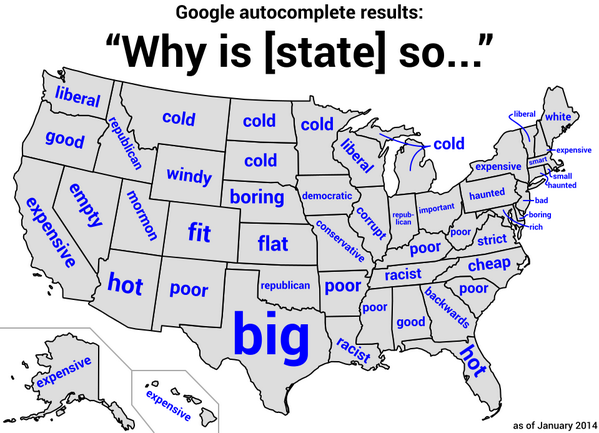
Huffington Post
Apart from Ohio, which was dubbed "important" presumably because of its influence as a swing state in presidential elections, and Oregon ("good") or Colorado ("fit"), it's hard to call any of theses results a compliment. Nebraska is apparently "boring." Georgia is "backwards." Pennsylvania is "haunted." Rents in California, New York, Hawaii, New Hampshire and Alaska (!?!) have people thinking those states are too "expensive." A good few (South Carolina, Mississippi, Arkansas, Kentucky and West Virginia) were autocompleted as "poor."
Nevada Poll: Most Favor Gun Background Checks and Like Pizza

National Rifle Association President David Keene, left, announces the NRA's endorsement of Sen. Dean Heller, R-Nev., right, at The Gun Store in Las Vegas Friday, Oct. 12, 2012. (John Locher/Las Vegas Review-Journal)
The Las Vegas Review-Journal
A new Nevada poll suggests that expanding gun background checks is as popular as pizza.
It’s not that simple, of course, since gun control is a lot more complicated than a cheesy pie.
The survey of 688 Nevada voters was conducted Jan. 20-21 by Public Policy Polling for the liberal groups, ProgressNow Nevada and the Center for American Progress Action Fund. It has a margin of error of plus or minus 3.7 percentage points.
According to the poll, 78 percent of Nevadans support requiring a criminal background check of every person who wants to buy a firearm. Some 14 percent were opposed and 8 percent weren’t sure.
Asked “do you like pizza or not,” 80 percent said they did, 7 percent said they didn’t and 13 percent said they weren’t sure. (Not sure? That might have been the most puzzling answer in the poll.)
With school, college campus and hospital shootings making headlines recently, policymakers have been looking for ways to allow Americans to enjoy their Second Amendment right to bear arms while also trying to keep guns out of the hands of those who might turn to violence.
But universal gun background check legislation has failed at both the federal and state levels.
U.S. Sen. Dean Heller, R-Nev., voted against a bill that would have expanded criminal background checks to all gun sales at gun shows and online, one poll question noted.
Asked if Heller’s vote would make you more or less likely to vote for him, 20 percent said more likely, 43 percent said less likely, 35 percent said it wouldn’t matter and 2 percent weren’t sure. Heller isn’t up for re-election until 2018.
Nevadans were split on Heller’s popularity: 39 percent had a favorable opinion of him, 40 percent had an unfavorable opinion and 21 percent weren’t sure.
In another question, the pollster noted that last year both houses of the Nevada Legislature voted in favor of a bill to require a background check on all gun sales, but Gov. Brian Sandoval vetoed the measure.
Nearly 10,000 American Children are Injured or Killed by Guns Every Year
MSNBC
Over 7,000 children are hospitalized or killed due to gun violence every year, according to a new study published in the medical journal Pediatrics. An additional 3,000 children die from gun injuries before making it to the hospital, bringing the total number of injured or killed adolescents to 10,000 each year.
The new study, led by researchers at the Yale School of Medicine, highlights the toll gun violence has on child mortality rates in the country. Doctors surveyed the most recently released data from 2009 that tracked pediatric hospital stays.
“This study reinforces what we know from the mortality data,” Daniel Webster, the director of the Johns Hopkins Center for Gun Policy and Research, told NBC News. “We have an extraordinary health burden in our youth associated with firearms injuries.”
In the 2009 Kids’ Inpatient Database (KID), 7,391 children under the age of 20 had been hospitalized for injuries from firearms and the majority of those gunshot injuries —4,559—resulted from intentional firearm assaults. 2,149 of those injured were accidents, and 270 were suicide attempts. Of the children who were hospitalized, 453 – 6% – died from their injuries.
“That’s more than 7,000 children injured badly enough to be hospitalized,” said the study’s lead author, Dr. John Leventhal, a pediatrics professor at the Yale School of Medicine. “All are unnecessary hospitalizations because preventing gun violence is something that can actually be done.”
I almost didn't post this. I hate studies that call under-20-year-olds children, not because it's inaccurate - they could certainly be considered children, but because it gives you gun-rights fanatics fodder for complaint and an easy way to divert the discussion.
If I were in charge of the study, I'd have done under-18. The numbers still would have been impressive enough.
Having said that, the point of the article is in the last sentence that I posted.
Subscribe to:
Posts (Atom)