Buffalo News op-ed
Showing posts with label torture. Show all posts
Showing posts with label torture. Show all posts
Saturday, December 20, 2014


Monday, November 5, 2012
Romney on Waterboarding
via Same Facts
Just in case there was any doubt, here’s the audio.
I can’t make out every word, but I could make out the gist:
Barack Obama banned it. And W. Mitt Romney wants to use it.
Any questions?
Just in case there was any doubt, here’s the audio.
I can’t make out every word, but I could make out the gist:
Q: Waterboarding: do you think it’s torture?Of course waterboarding – repeated partial drowning – is torture. It’s war crime under inernational law; as John McCain once said, we hanged a couple of Japanese admirals for it. It’s also a felony under the laws of the United States.
Romney: I don’t. … We will have a policy of doing what we think is in our best interest. We’ll use enhanced interrogation techniques that go beyond what’s in the military handbook right now.
Barack Obama banned it. And W. Mitt Romney wants to use it.
Any questions?
Friday, December 2, 2011
Amnesty International Says "Arrest George W. Bush"
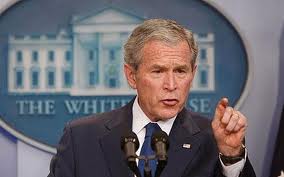
They're speaking to Ethiopia, Tanzania and Zambia, but the whole world hears it.
"All countries to which George W. Bush travels have an obligation to bring him to justice for his role in torture," said Matt Pollard, senior legal adviser.What do you think? Is that Malaysia news beginning to have a ripple effect?
Amnesty International recognizes the value of raising awareness about cervical and breast cancer in Africa, the stated aim of the visit, but this cannot lessen the damage to the fight against torture caused by allowing someone who has admitted to authorizing water-boarding to travel without facing the consequences prescribed by law.
"International law requires that there be no safe haven for those responsible for torture; Ethiopia, Tanzania and Zambia must seize this opportunity to fulfill their obligations and end the impunity George W. Bush has so far enjoyed," said Pollard.
Please leave a comment.
Wednesday, August 31, 2011
Saturday, August 6, 2011
Follow This Interview to the Sales of Guns, Ammo and Providing Gun Repair Trade
I would point out that this is the 3rd known law suit that has been given the go-ahead by federal courts against former Sec.of Defense, Donald Rumsfeld for torturing U.S. citizens. There is serious and credible reason to believe there may be more.
I believe Mr. Vance is a hero, and a true patriot, for the risks he took, and the pain he underwent, in addressing the illegal sale of firearms, ammo, and firearm repair.
I believe Mr. Vance is a hero, and a true patriot, for the risks he took, and the pain he underwent, in addressing the illegal sale of firearms, ammo, and firearm repair.
Friday, May 13, 2011
Friday, November 5, 2010
I Say Indict the Bums
Mike Licht has a post up about George W. Bush's book which is coming out in which he admits to authorizing torture.
Mike's conclusion:
Please leave a comment.
Mike's conclusion:
What's your opinion? Do you find it admirable that the former president is admitting this? Or does such an admission further damage the already poor reputation of the United States.Waterboarding is not just criminal, cruel, and inhumane. It is also useless and unproductive.
Please leave a comment.
Thursday, September 16, 2010
Spc. Alyssa Peterson
The Huffington Post published a fascinating article on the young woman who killed herself in Iraq after refusing to take part in torturing prisoners.
It's a heartbreaking story which puts a spotlight on the issue of extreme interrogation techniques.
I don't count myself among the liberal voices who denounce all this torture business accross the board. I've watched Jack Bauer use torture for the greater good. I admit, although his is a fictional character, there may be cases in which it is necessary. I don't fancy myself in a position to judge such things.
What I do have a problem with is that under Bush and Cheney these practices were legitimized. I don't think anyone doubts that police and military and everyone else in power have used certain unsavory methods, and this applies to all countries in all times, but to put the spotlight on them and claim they're acceptable did serious harm to the reputation of the United States. And that happened under Bush.
What's your opinion? Please leave a comment.
It's a heartbreaking story which puts a spotlight on the issue of extreme interrogation techniques.
I don't count myself among the liberal voices who denounce all this torture business accross the board. I've watched Jack Bauer use torture for the greater good. I admit, although his is a fictional character, there may be cases in which it is necessary. I don't fancy myself in a position to judge such things.
What I do have a problem with is that under Bush and Cheney these practices were legitimized. I don't think anyone doubts that police and military and everyone else in power have used certain unsavory methods, and this applies to all countries in all times, but to put the spotlight on them and claim they're acceptable did serious harm to the reputation of the United States. And that happened under Bush.
What's your opinion? Please leave a comment.
Monday, August 31, 2009
O'Rielly on Torture
Analysis by LiberalViewer.
What's your opinion? Do you put Bill O'Rielly in the same category with Glenn Beck? To me, Bill seems far more dangerous, although I would imagine their audiences are comprised of the same people for the most part.
Why would anyone oppose a full investigation into this as the ACLU suggests?
What's your opinion? Please leave a comment.
What's your opinion? Do you put Bill O'Rielly in the same category with Glenn Beck? To me, Bill seems far more dangerous, although I would imagine their audiences are comprised of the same people for the most part.
Why would anyone oppose a full investigation into this as the ACLU suggests?
What's your opinion? Please leave a comment.
Friday, April 10, 2009
CIA to Close Secret Prisons
The New York Times published two articles written by Scott Shane on the announcement from the CIA that they'd be closing the secret prisons. In the first story, which Talk Left posted about, the very important point was made that they "will no longer use contractors to conduct interrogations." The second article included the statement by agency’s director.
This would be in spite of the fact that Panetta and other top Obama administration officials have said they believe that waterboarding, the near-drowning method used in 2002 and 2003 on three prisoners, is torture, which is illegal under American and international law.
What do you think about this? Is the fact that torture and secret prisons are things of the past, or is it necessary to prosecute people for having been involved? Is the CIA Director right to say that his people should not be investigated or charged with wrongdoing?
Is the fact that these black sites have been closed and that torture is no longer utilized a feather in Obama's cap? Should he be credited for accomplishing this as he promised during the campaign?
What's your opinion? Please feel free to leave a comment.
Leon E. Panetta, said agency officers who worked in the program “should not be investigated, let alone punished” because the Justice Department under President George W. Bush had declared their actions legal.
This would be in spite of the fact that Panetta and other top Obama administration officials have said they believe that waterboarding, the near-drowning method used in 2002 and 2003 on three prisoners, is torture, which is illegal under American and international law.
In his first week in office, President Obama banned coercive interrogations and ordered the C.I.A. program closed. Mr. Panetta said that the C.I.A. had not detained any terrorism suspects since he took office in February and added that any suspects captured in the future would be quickly turned over to the American military or to a suspect’s home country.
What do you think about this? Is the fact that torture and secret prisons are things of the past, or is it necessary to prosecute people for having been involved? Is the CIA Director right to say that his people should not be investigated or charged with wrongdoing?
Is the fact that these black sites have been closed and that torture is no longer utilized a feather in Obama's cap? Should he be credited for accomplishing this as he promised during the campaign?
What's your opinion? Please feel free to leave a comment.
Friday, March 20, 2009
Torture
Last week, the New York Times published an op-ed by Mark Danner entitled Tales from Torture's Dark World. The article profiles several cases of torture victims who were interviewed by the Red Cross.
Mark Danner says, "this speech will stand as George W. Bush’s most important: perhaps the only historic speech he ever gave. In his fervent defense of his government’s “alternative set of procedures” and his equally fervent insistence that they were “lawful,” he set out before the country America’s dark moral epic of torture, in the coils of whose contradictions we find ourselves entangled still."
What do you think about that? Was the president acting in good faith and doing what he believed was best for the country? Do you think it worked? Even Mr. Danner admits we don't know the answer to that.
He goes on to point out that what we do know "with certainty, in the wake of the Red Cross report, is that the United States tortured prisoners and that the Bush administration, including the president himself, explicitly and aggressively denied that fact."
Do you agree with all that talk about America having lowered itself by engaging in these practices? Do you think our world reputation has suffered as a result? Do you think it was worth it, did the good gained outweigh the bad?
I know we've all talked about it before, but I never really got it. How could President Clinton have been impeached for what he did and President Bush not? Can someone please explain that to me?
Indeed, since the detainees were kept strictly apart and isolated, both at the black sites and at Guantánamo, the striking similarity in their stories would seem to make fabrication extremely unlikely. As its authors state in their introduction, “The I.C.R.C. wishes to underscore that the consistency of the detailed allegations provided separately by each of the 14 adds particular weight to the information provided below.”
As everyone knows, these interrogation techniques were approved at the highest levels and based on recent comments by the former president and by the former vice president, there are no regrets.
Mark Danner says, "this speech will stand as George W. Bush’s most important: perhaps the only historic speech he ever gave. In his fervent defense of his government’s “alternative set of procedures” and his equally fervent insistence that they were “lawful,” he set out before the country America’s dark moral epic of torture, in the coils of whose contradictions we find ourselves entangled still."
What do you think about that? Was the president acting in good faith and doing what he believed was best for the country? Do you think it worked? Even Mr. Danner admits we don't know the answer to that.
As I write, it is impossible to know definitively what benefits — in intelligence, in national security, in disrupting Al Qaeda — the president’s approval of use of an “alternative set of procedures” might have brought to the United States. Only a thorough investigation, which we are now promised, much belatedly, by the Senate Intelligence Committee, can determine that.
He goes on to point out that what we do know "with certainty, in the wake of the Red Cross report, is that the United States tortured prisoners and that the Bush administration, including the president himself, explicitly and aggressively denied that fact."
We can also say that the decision to torture, in a political war with militant Islam, harmed American interests by destroying the democratic and Constitutional reputation of the United States, undermining its liberal sympathizers in the Muslim world and helping materially in the recruitment of young Muslims to the extremist cause. By deciding to torture, we freely chose to embrace the caricature they had made of us. The consequences of this choice, legal, political and moral, now confront us. Time and elections are not enough to make them go away.
Do you agree with all that talk about America having lowered itself by engaging in these practices? Do you think our world reputation has suffered as a result? Do you think it was worth it, did the good gained outweigh the bad?
I know we've all talked about it before, but I never really got it. How could President Clinton have been impeached for what he did and President Bush not? Can someone please explain that to me?
Sunday, December 21, 2008
"The Experiment Requires That You Go On"
CNN ran a story today about the so-called "shock" experiment that took place at Yale University in the early 1960s. The legacy of Stanley Milgram, who died 24 years ago on December 20, reaches far beyond that initial round of experiments.
His experiment in its standard form included a fake shock machine, a "teacher," a "learner" and an experimenter in a laboratory setting. The participant was told that he or she had to teach the student to memorize a pair of words, and the punishment for a wrong answer was a shock from the machine.
In my personal experience, I have two situations that relate. One is a lifelong observation of people in positions of power. My belief is that 95% abuse that power. Much of that abuse is minor, I grant you, a tone of voice, a disparaging look, but it counts as abuse in my book. On the other extreme of the spectrum are cases of police brutality, domestic violence and such. The CNN article talks about the Stanford Prison Experiment which addresses this tendency. And, of course, that famous aphorism, "Power corrupts and absolute power corrupts absolutely," covers it too.
Another personal experience is the tendency of people working in bureaucratic organizations who go into what I call "compliance mode." This is when explicit or implicit orders come down from above and the middle level manager blindly obeys, too often enthusiastically. Sometimes these policies or instructions are badly thought-out, I suppose the ones making these decisions are too far removed from the ones who will actually implement them to have a real feel for their efficacy. The result is ever increased difficulty wading through the already difficult paper shuffling.
I'm happy to report that I've resisted both of these types of behavior, usually as a recipient by expressing my opposition in various ways, and sometimes as a doer by simply trying to avoid or diminish the problem. How about you? Have you seen these things at work? How have you reacted and what have you done?
As a prison guard, would you abuse your power? If it's true that most would, what does this say about the prison guards working today? Should something be done about that?
Please feel free to comment.
His experiment in its standard form included a fake shock machine, a "teacher," a "learner" and an experimenter in a laboratory setting. The participant was told that he or she had to teach the student to memorize a pair of words, and the punishment for a wrong answer was a shock from the machine.
The teacher sat in front of the shock machine, which had 30 levers, each corresponding to an additional 15 volts. With each mistake the student made, the teacher had to pull the next lever to deliver a more painful punishment.
While the machine didn't generate shocks and a recorded voice track simulated painful reactions, the teacher was led to believe that he or she was shocking a student, who screamed and asked to leave at higher voltages, and eventually fell silent.
If the teacher questioned continuing as instructed, the experimenter simply said, "The experiment requires that you go on," said Thomas Blass, author of the biography "The Man Who Shocked The World: The Life and Legacy of Stanley Milgram" and the Web site StanleyMilgram.com.
About 65 percent of participants pulled levers corresponding to the maximum voltage -- 450 volts -- in spite of the screams of agony from the learner.
Mr. Blass concludes that most people when confronted with a legitimate authority figure will act against their conscience if called to do so. Do you think that's true? Would anyone offer a comment admitting that he or she could be one of them? Not me, I hasten to tell you.In my personal experience, I have two situations that relate. One is a lifelong observation of people in positions of power. My belief is that 95% abuse that power. Much of that abuse is minor, I grant you, a tone of voice, a disparaging look, but it counts as abuse in my book. On the other extreme of the spectrum are cases of police brutality, domestic violence and such. The CNN article talks about the Stanford Prison Experiment which addresses this tendency. And, of course, that famous aphorism, "Power corrupts and absolute power corrupts absolutely," covers it too.
Another personal experience is the tendency of people working in bureaucratic organizations who go into what I call "compliance mode." This is when explicit or implicit orders come down from above and the middle level manager blindly obeys, too often enthusiastically. Sometimes these policies or instructions are badly thought-out, I suppose the ones making these decisions are too far removed from the ones who will actually implement them to have a real feel for their efficacy. The result is ever increased difficulty wading through the already difficult paper shuffling.
I'm happy to report that I've resisted both of these types of behavior, usually as a recipient by expressing my opposition in various ways, and sometimes as a doer by simply trying to avoid or diminish the problem. How about you? Have you seen these things at work? How have you reacted and what have you done?
As a prison guard, would you abuse your power? If it's true that most would, what does this say about the prison guards working today? Should something be done about that?
Please feel free to comment.
Subscribe to:
Posts (Atom)